

Peyronie’s disease
Diagnosis, disease stages, and modern treatment approaches
Mild penile curvature is relatively common and is not always pathological. A slight curvature may not interfere with sexual activity and may be purely cosmetic.
However, in some cases, curvature is associated with a condition that requires medical attention: Peyronie’s disease (fibroplastic induration of the penis).
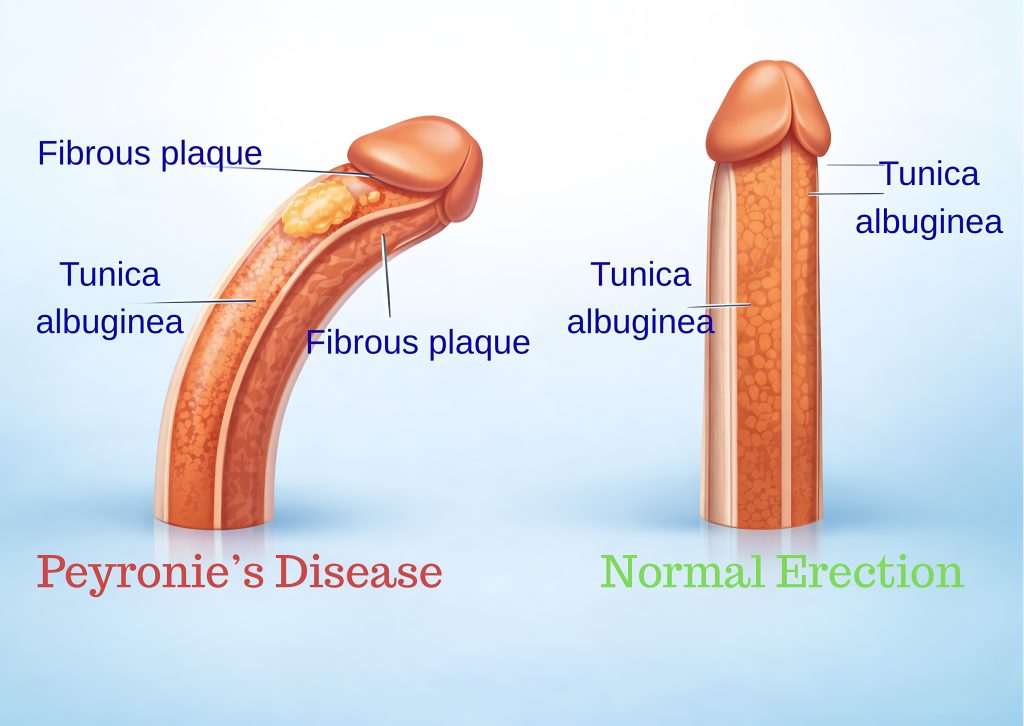
In Peyronie’s disease, dense fibrous formations (plaques) develop in the tunica albuginea of the corpora cavernosa, disrupting tissue elasticity and leading to penile curvature, most often upward or to the side. Unlike congenital deformities, Peyronie’s disease is often accompanied by pain during erection.
How Peyronie’s Disease Develops
The disease develops gradually and проходит several stages.
At the initial stage, an inflammatory reaction occurs and fibrous tissue begins to form. During this period, the plaque may still be soft and responsive to treatment.
As the disease progresses, the fibrosis becomes denser and may increase in size, leading to pronounced penile deformity, shortening, and deterioration of erectile function.
The stage of the disease plays a key role in determining the treatment strategy.
Main Causes of Peyronie’s Disease
There is no single cause of Peyronie’s disease. Most often, the condition develops as a result of a combination of several factors:
- microtrauma of the tunica albuginea of the corpora cavernosa
- chronic trauma to the penis
- inflammatory processes
- endocrine disorders
- hypogonadism
- genetic predisposition
- autoimmune mechanisms
In most cases, the triggering factor is repeated microtrauma, which may occur with certain sexual practices.
Main Symptoms of Peyronie’s Disease
At different stages of the disease, patients may notice:
- the appearance of a lump or plaque in the penile area
- pain during erection
- changes in the shape or
- direction of erection
- progressive curvature
- reduction in penile length
- deterioration in erection quality
The severity of symptoms may change over time, which often makes it difficult to independently assess the stage of the disease.
Diagnosis of Peyronie’s Disease
The diagnosis is established based on a comprehensive assessment of:
- clinical examination of the patient
- medical history and analysis of symptom dynamics
- penile ultrasound
Ultrasound allows determination of the size, density, and location of the fibrous plaque, as well as assessment of vascular blood flow.
How Quickly Peyronie’s Disease Progresses
Peyronie’s disease develops gradually, and the rate of its progression can vary significantly among patients. In most cases, the condition проходит two main phases:
At the initial stage (active phase), an inflammatory reaction occurs in the tissues of the tunica albuginea of the penis and a fibrous plaque begins to form. During this period, the patient may experience pain during erection, as well as gradual changes in penile shape. This stage usually lasts from several months up to 12–18 months.
As the disease progresses, the plaque becomes denser, may increase in size, and lead to more pronounced curvature. In some cases, penile shortening and deterioration of erectile function may occur.
After the active phase is completed, the disease enters a stable stage. During this period, pain usually decreases or disappears, but the deformity becomes fixed and does not change on its own.
The rate of disease progression depends on individual characteristics of the body, including the presence of comorbid conditions and repeated microtrauma. In some patients, changes may develop relatively quickly — within a few months, while in others the process takes a longer time.
Timely diagnosis at an early stage significantly expands the possibilities of conservative treatment and, in some cases, helps avoid surgical intervention.
Approaches to the Treatment of Peyronie’s Disease
The treatment strategy for Peyronie’s disease is determined by the stage of the condition, the severity of the deformity, and the state of erectile function.
In the early phase, when the plaque is forming, conservative treatment methods may be used to reduce inflammation and prevent the progression of fibrosis.
In cases of pronounced deformities, plaque calcification, or decreased erectile function, surgical correction methods may be considered.
Why It Is Important to Determine the Stage of the Disease
The effectiveness of treatment directly depends on the stage at which the patient seeks medical care.
Early diagnosis expands the possibilities of conservative treatment and, in some cases, helps avoid surgical intervention.
At later stages, effective correction methods also exist; however, they require an individualized approach and more complex solutions.
Determining the stage of the disease makes it possible to understand whether conservative management is feasible or if a surgical approach is required.
Where to Go Next
Depending on the clinical situation, different treatment pathways are possible:
- If the disease is in the active phase, conservative and injection-based methods are considered
(Active phase: pain → change in shape → plaque growth)
- In cases of pronounced deformity, microsurgical approaches are used
(Stable phase: pain decreases → deformity becomes fixed)